
Enterprise Vibe Coding for Agentic Engineering: An Honest Review of the Playbook for Steering Coding Agents
An honest review of Enterprise Vibe Coding for Agentic Engineering by Valentina Alto (Packt). Why the book is an operating model for steering coding agents in a real repository, not a guide to better prompts.
AI coding agents have made the first draft of software nearly free. They have not made reviewing it, securing it, or owning it any cheaper, and that gap is the whole subject of Enterprise Vibe Coding for Agentic Engineering by Valentina Alto.
To be upfront about what this review is: I read the book cover to cover, then applied its primitives to how I actually work with agents. That includes the repository behind this blog, where an agent drafts and checks posts under rules I wrote, and agent setups at work that I will keep generic. So this is a review of the ideas, and also of what happened when I tried them.
The short version: the title undersells it. "Vibe coding" sounds like a book about prompting your way to an app. This is a book about the opposite: how to keep the speed while putting humans back in charge of the decisions.
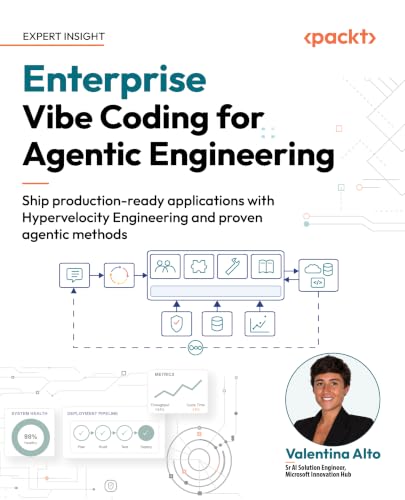
Quick verdict: Enterprise Vibe Coding for Agentic Engineering is an operating model for steering coding agents inside a real repository. Its real subject is ownership, not generation. Best for tech leads, senior engineers, and platform teams who already have agents writing code and now need it to be reviewable.
What is Enterprise Vibe Coding for Agentic Engineering?
Enterprise Vibe Coding for Agentic Engineering (Packt, August 2026) is a 192-page, 8-chapter playbook for adopting AI coding agents in enterprise software delivery. It introduces Hypervelocity Engineering (HVE), an operating model in which humans define intent, constraints, and risk tolerance while agents execute within explicit boundaries, and builds it from six primitives, a Research, Plan, Implement cadence, and layered governance.
The author, Valentina Alto, is a Senior AI Solution Engineer at the Microsoft Innovation Hub in Dubai and has written two earlier books on generative AI. The preface aims the book at technology leaders, senior engineers, architects, platform teams, and governance professionals, and is refreshingly honest that "building that methodology is part of the purpose of the book." Nobody arrives with an established method for working with agents yet.
Hands-on examples use GitHub Copilot, with Microsoft Agent Framework patterns in the use cases, and the text keeps pointing out the Claude Code equivalents. You need Git, pull requests, testing, and CI/CD fluency to get the most from it.
The thesis: software generation is cheap, judgment is not
Chapter 1 opens with the economics, and it is the most persuasive framing of the problem I have read.
The book backs this with the numbers it cites, which I reproduce here as the book presents them:
| Source cited in the book | Finding |
|---|---|
| Controlled study, 95 professional developers | Copilot users finished a JavaScript task 55% faster |
| Faros AI, 10,000 developers across 1,255 teams | High AI adoption: 21% more tasks, 98% more merged PRs, and 91% longer PR review time |
| CodeRabbit, 470 open-source PRs | 10.83 issues per AI-authored PR vs 6.45 for human-only (about 1.7x) |
| Aikido Security 2026 survey, 450 practitioners | 69% of organizations found vulnerabilities introduced by AI-generated code |
Read together, they say what every team running agents already feels: generation got faster, and review became the bottleneck. Alto's answer is not "generate less." It is to build the system that makes generated work reviewable, and that system is what the rest of the book constructs.
Why the structure is the argument
The book is short, and every chapter adds one layer to the operating model:
- Chapters 1 and 2 set the paradigm: why vibe coding works for prototypes and breaks at enterprise scale, the HVE maturity spectrum (from traditional development through AI-assisted, vibe coding, and structured agentic development to AI-native), and the human-agent working contract.
- Chapter 3 introduces the six primitives: instructions, prompts, agents, skills, hooks, and MCP.
- Chapter 4 runs those primitives across the full SDLC using one scenario, FlowDesk (an agentic IT service copilot), with the Research, Plan, Implement (RPI) cadence as the through-line.
- Chapter 5 is governance, from stochastic to deterministic, in five layers.
- Chapter 6 proves the stack with three blueprints: a travel agency built on agent handoffs, a conversational shopping assistant, and multi-channel marketing campaign generation.
- Chapter 7 is loop engineering: delivery loops that discover, plan, execute, verify, recover, and complete with explicit human gates.
- Chapter 8 connects HVE to the wider Agentic SDLC discussion and to agent experience (AX).
Read that way, the chapters form a build order. Vocabulary first, then cadence, then boundaries, then automation. Skip a layer and the next one does not hold.
The six agentic primitives, and how I applied them
Chapter 3 is the one I kept open while working. Its claim is that one-off prompting becomes engineering when knowledge lives in versioned files the runtime loads automatically. Here is how each primitive maps onto my setup, with the gaps stated plainly:
| Primitive | What the book means | Where it shows up in my setup |
|---|---|---|
| Instructions | The always-on rulebook, scoped from global to path-specific | A repo rule that bans em dashes in every file, plus user-level rules: no git add, commit, or push without explicit approval, and no AI attribution in commit messages |
| Skills | Packaged procedures: "instructions define rules; skills define recipes" | A new-blog skill that chains a writing guide, an AI-SEO pass, and an SEO audit, then runs the test and build commands before anything ships |
| Hooks | Deterministic checks that run at defined points | Closest equivalent: a postbuild SEO audit that fails the build on missing or duplicate metadata and empty image alt text. It is a build gate rather than an agent lifecycle hook, which puts it in the book's policy-as-code layer |
| Agents | Named collaborators with scoped tools and an escalation rule | At work: separating read-only exploration agents from write-capable ones, and running a plan step before any edit |
| MCP | The standard connection to tools and data, treated as a production dependency | At work: starting connectors read-only and keeping tool access narrow, exactly the "start read-only" rule the book recommends |
| Prompts | Reusable task templates with inputs and expected output | Reusable task prompts at work. This is the primitive I have formalized least |
The change that mattered most was not any single file. Rules that used to live in my head, or in a correction I typed for the fifth time, now live in the repository and apply to every session. That is the book's argument in miniature: primitives "move knowledge out of people's heads and into the repository, where it evolves through normal review."
The ideas that stuck with me
These are the parts I expect to keep reusing, not just the parts that read well.
Two lines capture the book's tone:
"This pattern shows that software generation is cheap, but judgment is not."
"Collapse the gap between 'the model probably did the right thing' and 'the system could not have done the wrong thing.'"
Chapter 8 then reframes all of it as agent experience. When an agent works for an hour while you are in a meeting, good AX means you return to a clear account of what changed, which assumptions it made, which tests it ran, and which decision now needs you, not a transcript to reconstruct. That is a useful test for any agent workflow you already run.
The companion GitHub repository ships reusable templates and primitives, and the book points to Microsoft's hve-core collection for more. Copying a skill or hook from either is the fastest way to see whether the pattern fits your repository.
Where it falls short
No book earns a real review without the criticism, so here is mine.
It is a Microsoft and Copilot book first. HVE is introduced as "Microsoft's answer," the solution accelerators that make prototypes credible are Microsoft's, and the examples default to .github/ paths and the Microsoft Agent Framework. The Claude Code notes help, and the model is portable, but you will translate as you go.
The headline numbers deserve skepticism. Several of the most striking statistics come from vendors that sell into this market (Faros AI, CodeRabbit, Aikido Security). The direction is consistent and matches experience, but treat the exact percentages as indicative rather than settled.
Tool details will age faster than the model. Copilot CLI commands, autopilot continuation limits, and specific file conventions are already moving. The primitives, RPI, and the stochastic-to-deterministic spectrum are the parts that will still hold in two years.
Blueprints, not builds. At 192 pages, the three Chapter 6 use cases show the primitives, flow, and governance highlights for each scenario. They are good reference architectures, but they are not end-to-end implementations you can lift.
How it compares to other agent books I have reviewed
The useful distinction is between building agents and building software with agents.
| Aspect | Enterprise Vibe Coding | 30 Agents Every AI Engineer Must Build | Mastra Patterns for Building AI Agents |
|---|---|---|---|
| Subject | Using coding agents to deliver software | Building agent systems as products | Getting agent products into production |
| Primary reader | Tech leads, platform teams, governance owners | AI and backend engineers | TypeScript developers shipping agents |
| Stack | GitHub Copilot, Microsoft Agent Framework, MCP | Python, LangChain and LangGraph | Mastra, TypeScript |
| Governance depth | Core of the book (five layers, policy-as-code, audit) | Dedicated chapters on verification and ethics | Security and evals sections |
| Length | 192 pages | 542 pages | About 92 pages |
If you build agent products, start with my reviews of 30 Agents Every AI Engineer Must Build and Principles and Patterns of Building AI Agents. If agents already write your code, this is the one to read.
Who should read Enterprise Vibe Coding for Agentic Engineering
Read this if coding agents already touch a shared repository and you are the person who has to answer for what they ship: a tech lead, staff engineer, platform owner, or engineering manager. It gives you a vocabulary for that conversation and a sequence for introducing controls without killing the speed.
Skip it if you want to learn how to build an agent product, or if you want a deep implementation manual. It is a playbook, and it is honest about that.
For the career side of the same shift (which roles grow as humans move above the loop, and how to prove you can do them), see my review of The Generative AI Career Masterplan.
Final word
Enterprise Vibe Coding for Agentic Engineering takes the most hyped phrase in software and turns it into its opposite: a disciplined, layered way to keep generated code ownable. The primitives gave me a vocabulary for setups I had half-built by instinct, and the stochastic-to-deterministic spectrum changed how I decide what belongs in a prompt versus a gate. It loses half a point for its Microsoft lens, vendor-sourced numbers, and details that will date quickly. 4.5 / 5, and the one I would hand to any team whose review queue has started growing faster than its codebase.
Disclosure: Packt sent me a review copy of this book. Thank you to Vinishka Kalra for sharing it with me, and a real thank you to Valentina Alto for writing a book that treats governance as engineering rather than paperwork.
You can find the book on Amazon and via Packt, and the companion code on GitHub. If you read it, I would like to know which primitive you added to your repository first.
Frequently asked questions
What is Enterprise Vibe Coding for Agentic Engineering about?
It is a 192-page, 8-chapter book by Valentina Alto (Packt, August 2026) that lays out an operating model for using AI coding agents in enterprise software delivery. It moves from vibe coding to steered agentic development, then builds the model from six primitives, the Research, Plan, Implement (RPI) cadence, a five-layer governance approach, three end-to-end use cases, and loop engineering.
What is Hypervelocity Engineering (HVE)?
HVE is the book's name for an AI-native delivery model in which small, multidisciplinary teams of about four to five people use AI agents, continuous automation, and a shared library of reusable primitives to ship production software. The book presents it as Microsoft's answer to vibe coding's speed without its inconsistency, fragility, and governance gaps, and pairs it with a five-level maturity model.
What are the six agentic primitives in the book?
Instructions (the always-on rulebook), prompts (reusable task templates), agents (named collaborators with a defined scope and tools), skills (packaged procedural knowledge), hooks (deterministic checks that run at lifecycle events), and MCP (the standard connection to external tools and data). The book's point is that they work together, orchestrated by the runtime, rather than as isolated files.
Is the book only useful if you use GitHub Copilot?
No, but Copilot is the default lens. The hands-on examples use GitHub Copilot file paths and Microsoft Agent Framework patterns, and the text regularly notes the Claude Code equivalents (CLAUDE.md, .claude/skills, settings.json hooks). The operating model transfers to any agent runtime with rules, skills, hooks, and MCP, but you will translate filenames and configuration.
What is the main weakness of the book?
Its Microsoft and Copilot slant, plus details that will age quickly. HVE is framed as Microsoft's model, the solution accelerators are Microsoft's, several headline productivity statistics come from vendors, and specific CLI features will change. At 192 pages the three use cases are blueprints rather than complete builds.
 Written byBrian CastelinoAI Data Engineer at WorldLink US. I ship ML and LLM systems into production on Databricks and write about what breaks along the way.