
The Generative AI Career Masterplan: An Honest Review of the Five-Author Roadmap to an AI Career
An honest review of The Generative AI Career Masterplan by Ali Arsanjani, Sadid Hasan, Maxime Labonne, Andreas Horn, and Leonid Kuligin (Packt). A broad, evidence-first career roadmap whose career half is stronger than its technical half.
Most career books are written by one career coach or one engineer, and they read like it: a single path, generalized to everyone. The Generative AI Career Masterplan takes the opposite bet. Five practitioners from Google, Microsoft, and Liquid AI, with earlier careers at IBM and AWS, pooled what they look for when they hire and what they wish they had known.
To be upfront about what this review is: I read the book cover to cover as an AI data engineer who has written his own guide to building and tailoring a resume. I am reviewing the quality of the advice and how it holds up against what I have seen, not claiming that it landed me or anyone else a job.
The short version: it is two books in one. There is a technical primer on the GenAI stack, and there is a career guide. The career guide is the reason to buy it.
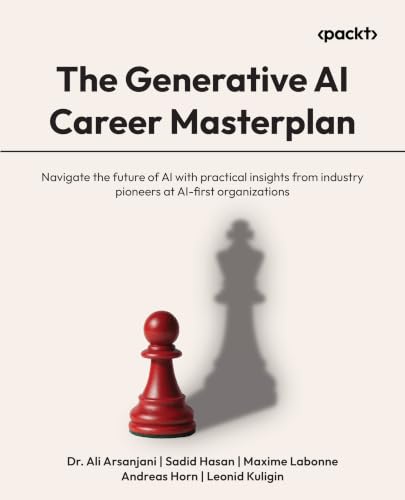
Quick verdict: The Generative AI Career Masterplan is a broad, evidence-first roadmap into AI work. Its real subject is proof: how to show you can do the job when polish is cheap. Best for career switchers and early-career engineers choosing a lane.
What is The Generative AI Career Masterplan?
The Generative AI Career Masterplan (Packt, 2026) is a roughly 300-page, 13-chapter career guide for the generative and agentic AI era. It moves from how AI is reshaping work, through a map of GenAI roles and the technical stack behind them, to the practical mechanics of getting hired: personal branding, AI-resilient resumes, portfolios, interviews, and the first 90 days in a new role.
It is written by five authors, each with a different vantage point on hiring:
- Dr. Ali Arsanjani, Director of Applied AI Engineering at Google Cloud and head of its GenAI Blackbelts, previously Head of Machine Learning at AWS and CTO for Analytics at IBM.
- Sadid Hasan, a Principal AI leader in Microsoft's Office of the CTO, previously Executive Director of AI at CVS Health.
- Maxime Labonne, Head of Post-Training at Liquid AI and author of the LLM Engineer's Handbook.
- Andreas Horn, an enterprise AI and automation leader who has worked with IBM and Microsoft.
- Leonid Kuligin, a Staff AI Engineer at Google Cloud and a maintainer of the Google Cloud integrations for LangChain.
The preface aims it at "graduates, professionals, and leaders," from people entering the job market to executives leading AI transformation.
The thesis: choose a career family, not a job title
The most useful idea in the book arrives in Chapter 3, and everything else hangs off it.
The five families are Builders (technical creation), Shapers (product and strategy), Guardians (risk, safety, and accountability), Enablers (operational integration), and Adopters (domain experts amplified by AI). AI Engineer, LLM Engineer, and GenAI Engineer are the same family with different labels, and so are Responsible AI, AI Governance, and AI Risk.
That framing is genuinely clarifying. Titles in this field change every six months; the underlying work does not. The third step, "define evidence," is the thread that runs through the strongest chapters.
Why the structure is the argument (and where it splits)
The book is organized in five parts:
- Part 1, Chapters 1 to 3: the landscape. AI's effect on jobs and strategy, core GenAI concepts, and the roles map with leveling roadmaps and pivot playbooks.
- Part 2, Chapters 4 and 5: the tech stack. Transformer, mixture-of-experts, and diffusion architectures, prompting, RAG design, agents, and a tour of model providers, LangGraph, LlamaIndex, Hugging Face, and fine-tuning tools.
- Part 3, Chapters 6 to 8: skills and strategy. Hard skills, skills for the agentic era, and career moves with a job leveling matrix.
- Part 4, Chapter 9: applied use cases across software development, CRM, marketing, finance, and healthcare, plus multi-agent systems.
- Part 5, Chapters 10 to 13: building and deploying LLM applications, then personal branding, the job market and interviews, and sustaining growth.
Read closely, this is a technical primer (Chapters 4 to 6, 9, and 10) interleaved with a career guide (Chapters 1 to 3, 7 and 8, and 11 to 13). The two halves serve different readers, and that tension shows up again in the criticism below.
The parts that stuck with me
These are the sections I expect people to actually use.
Two lines capture the book at its best:
"So do not prepare to 'answer questions.' Prepare to reduce uncertainty."
"Document what broke, how you measured it, and what you changed; that portfolio signal beats certificates." (Shaun Tyler, Körber Pharma)
That second line comes from Chapter 13's collection of short essays by enterprise AI leaders, including Francesca Rossi (IBM), Michael Drass (Deutsche Bahn), and Robert Engels (Capgemini). Each answers the same two questions about what matters for a lasting AI career. The answers repeat each other more than you might expect, and that repetition is the signal: fundamentals, evaluation discipline, domain depth, and documented proof.
How Chapter 12 compares to my resume guide
I wrote a long resume guide earlier this year, so I read Chapter 12 with a direct comparison in mind. The overlap is reassuring, and the differences are useful:
| Topic | The Generative AI Career Masterplan | My resume guide |
|---|---|---|
| Layout and file type | Single column, no tables or text boxes; .docx or text-based PDF; test by pasting into a plain text editor | Same structure rules; submit the requested format; paste and highlight tests |
| Bullet formula | Action, scope, mechanism, outcome, metric | Action verb, what you did, tool, quantified result |
| Keywords | Extract 10 to 20, mirror exact phrasing, never duplicate to game the system | Aim for a 70 to 80 percent thematic match, weave in 3 to 5 core terms |
| Must match the resume; use Featured for work samples | The "verifier" reader cross-checks LinkedIn, GitHub, and portfolio | |
| Using AI | Five ready-made prompts, most of which forbid inventing facts | Rewrite, do not fabricate; refine with AI, then use your own voice |
| Cover letters | Less important now; 200 to 300 words when requested | One page, structured as Hook, Proof, Close |
| Portfolio | Five specific projects, plus a live demo link | Project links and the reasoning behind key decisions |
| Interviews | Story bank, deep dives, targeted technical prep, AI for rehearsal | Out of scope beyond "defend every line" |
Where the book wins is everything after the resume: the portfolio projects and the interview method are more specific than anything in my guide. Where my guide goes further is the mechanics of the document itself: section order by career stage, the four readers a resume has to satisfy, and a self-audit checklist. Read together, they cover the whole path from a blank page to an offer.
Where it falls short
No book earns a real review without the criticism, so here is mine.
Five authors, five voices. Depth and tone shift noticeably from chapter to chapter. Some sections are crisp and opinionated; others read like survey material. The book even uses two role taxonomies: five career families in Chapter 3 and four job-market archetypes (Builders, Integrators, Operators, Enablers) in Chapter 12, where "Enablers" means something different.
The audience is too wide. The preface pitches the book to graduates, business analysts, educators, and executives. The same preface asks readers to have basic Python, ML concepts, LLM familiarity, and comfort with APIs. A non-technical manager will bounce off the fine-tuning chapter, and an AI engineer will skim the AI literacy chapter.
The technical half is a survey that will age. Chapters 4 to 6 and 10 are accurate and well organized, but they cannot compete with dedicated books, and specific tools date fast. Chapter 7 in particular is billed in the preface as human skills but spends much of its space on harness engineering, prompt injection, and named techniques and products that may not last. If you want technical depth on agents, read 30 Agents Every AI Engineer Must Build or the Mastra Principles and Patterns books instead.
Editing slips in the review copy. In the copy I read, one author bio repeats a paragraph nearly verbatim, and Part 4 carries the same title as Part 1 ("The Gen AI Landscape: Understanding the Revolution"). These are small and may be fixed in later printings, but they reinforce the sense of a book assembled from several hands.
How it compares to typical career books
| Aspect | The Generative AI Career Masterplan | Typical career books |
|---|---|---|
| Authorship | Five senior AI practitioners from Google, Microsoft, and Liquid AI | Usually one coach, recruiter, or engineer |
| AI specificity | Role families, leveling roadmaps, and pivot playbooks for GenAI work | Generic advice adapted for tech |
| Technical content | A full survey of the GenAI stack | Minimal or none |
| Evidence focus | Portfolio projects, proof signals, story banks | Mostly resume and interview tactics |
| Consistency | Uneven across authors | Usually a single, consistent voice |
Who should read The Generative AI Career Masterplan
Read this if you are moving into AI from another engineering, data, or domain role and need a map of where you could fit. It is also a good fit if you are early in your career and choosing what to specialize in, or a manager trying to understand which AI roles your team actually needs. The roles map, pivot playbooks, and Chapter 12 alone justify the price.
Skip it, or borrow it, if you are already an experienced AI engineer looking for technical depth. You will know most of the technical half, and the career half is aimed at people earlier in the journey.
Final word
The Generative AI Career Masterplan is at its best when it stops explaining the technology and starts explaining how hiring for it actually works. The career families, the pivot playbooks, the truth-preserving resume prompts, the portfolio projects, and the 90-day plan are specific, practical, and clearly written by people who sit on the other side of the interview table. It loses a point for unevenness across five authors, an audience that is too broad, and a technical half that will date faster than the career advice. 4.0 / 5, and the book I would hand to anyone asking me how to break into AI work.
Disclosure: Packt sent me a review copy of this book. Thank you to Dipali Malwatkar for sharing it with me, and thank you to Ali Arsanjani, Sadid Hasan, Maxime Labonne, Andreas Horn, and Leonid Kuligin for putting this much hiring-side experience into one place.
You can find the book on Amazon and via Packt. If you read it, I would like to know which career family you chose, and what evidence you are building for it.
Frequently asked questions
What is The Generative AI Career Masterplan?
It is a roughly 300-page, 13-chapter career guide (Packt, 2026) written by Dr. Ali Arsanjani (Google Cloud), Sadid Hasan (Microsoft), Maxime Labonne (Liquid AI), Andreas Horn (enterprise AI and automation, formerly IBM), and Leonid Kuligin (Google Cloud). It covers how generative AI is reshaping work, a map of GenAI roles, the technical stack, technical and human skills, applied use cases, and then personal branding, job search, interviews, and the first 90 days in a new AI role.
Who should read The Generative AI Career Masterplan?
Career switchers moving into AI, early-career engineers choosing a specialization, and managers trying to understand which AI roles they actually need. It is less useful for experienced AI engineers looking for technical depth, since the technical chapters are a survey rather than a deep treatment.
How technical is the book?
More technical than the title suggests. Chapters 4 to 6 and 10 cover transformer and mixture-of-experts architectures, RAG design, agents, LangGraph, LlamaIndex, Hugging Face, fine-tuning with TRL, Axolotl, and Unsloth, and evaluation. The preface asks for basic Python, ML concepts, LLM familiarity, and comfort with APIs, even though it also pitches the book to non-technical professionals and executives.
Does the book help with resumes and interviews?
Yes, and this is its strongest section. Chapter 12 gives a six-step method for an AI-resilient resume, five copy-paste LLM prompts (most with explicit guardrails against inventing facts), a master-versus-tailored resume workflow, five portfolio projects that signal technical maturity, and an interview method built on a story bank of 8 to 12 STAR stories weighted 20 percent context and 80 percent action and result.
What is the main weakness of the book?
Unevenness. Five authors produce noticeably different voices and depth, the book uses two different role taxonomies (five families in Chapter 3, four archetypes in Chapter 12), the audience ranges from graduates to executives while assuming Python and API skills, and the tool-specific material will date quickly.
 Written byBrian CastelinoAI Data Engineer at WorldLink US. I ship ML and LLM systems into production on Databricks and write about what breaks along the way.